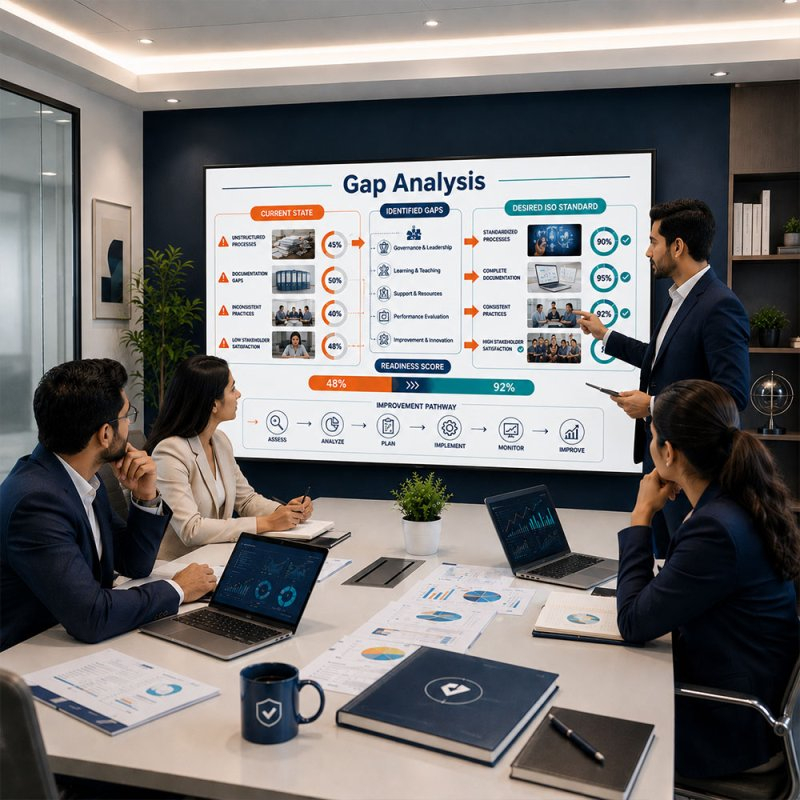
Before you take the first step toward ISO 21001 certification, it helps to know exactly where you stand. Our Gap Analysis & Readiness Assessment gives you that clarity — a clear, honest picture of where your institution is today and what it takes to get where you want to be.
A Gap Analysis is a structured evaluation of your institution's current operations, processes, and documentation — measured against the full requirements of ISO 21001. Think of it as a professional health check for your management system. We assess what you already have in place, identify what's missing, and map out the exact distance between your current position and full certification readiness.
It's not an audit, and it's not a judgment. It's a strategic starting point — one that saves you time, money, and surprises down the road.
This service is designed for any educational institution that is serious about pursuing ISO 21001 but isn't sure where to begin. Whether you're a school taking your first steps in quality management, a university looking to formalize what already works, or a training institute preparing for international recognition — the Gap Analysis is your most important first move.
It's also valuable for institutions that have attempted implementation before but stalled, or those who want an independent, expert perspective on their current state before committing to full consulting support.
At the end of the assessment, you'll receive a comprehensive Readiness Report — a professionally structured document that outlines:
You won't receive a generic checklist. You'll receive a roadmap — one that's specific to your institution and built to guide real decisions.
Jumping into implementation without a gap analysis is one of the most common and costly mistakes institutions make. Without understanding where your gaps lie, resources get spent in the wrong places, teams become overwhelmed, and timelines stretch. The readiness assessment prevents all of that.
It also gives leadership the confidence to move forward — because decisions are based on facts, not assumptions. When your team knows what's ahead, they can prepare with purpose.
Common challenges we identify: undocumented processes that rely on institutional memory, inconsistent practices across departments, unclear roles and responsibilities, absence of learner-focused quality indicators, and informal systems that have never been formally recorded.
Our consultants work with your team collaboratively — not invasively. We observe, we ask the right questions, and we listen. The result is a report that reflects your institution honestly and gives you a practical foundation to build on.